
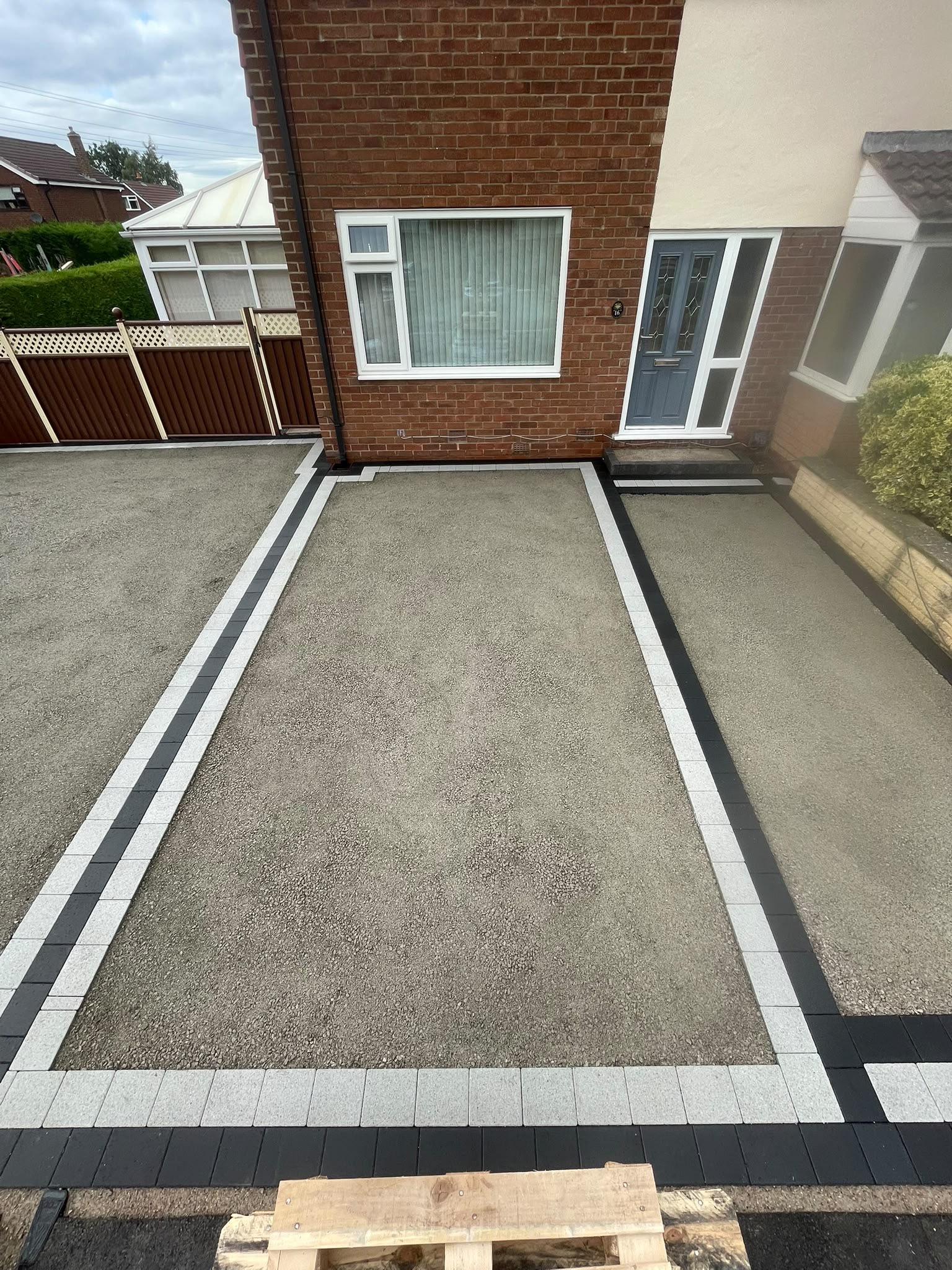
The best base for a resin driveway is not decided by appearance alone. It must be stable, suitable for the expected vehicle load and designed to manage water correctly. A high-quality resin surface laid over a weak or unsuitable base can still crack or fail.
Solid Ground assesses the existing construction, drainage, ground conditions and access before specifying a full excavation or overlay. This guide explains common base options and why there is no single specification for every property.
What Does a Resin Driveway Base Need to Do?
- Carry the expected vehicle loads without movement
- Provide a stable, continuous surface for the resin-bound layer
- Manage rainfall through permeability or designed drainage
- Be properly cured, clean and dry before resin is installed
- Accommodate edges, levels and connections to the pavement or paths
Manufacturer guidance from Derbyshire Specialist Aggregates lists tarmac, asphalt and concrete among possible bases, while stressing that the selected construction must suit the intended load. It also explains that a permeable resin system needs a suitable permeable base. See its guide to bases for resin-bound systems.
Permeable No-Fines Concrete
No-fines concrete uses a coarse aggregate structure with little or no fine sand, leaving connected voids that allow water to move through the base. When correctly designed for the site and expected traffic, it can provide a strong, continuous and permeable platform beneath resin-bound surfacing.
Solid Ground commonly uses a suitable no-fines concrete base on full resin installations where the ground conditions and drainage design make it appropriate. The required excavation, sub-base and concrete specification still depend on the individual property; “no-fines” is not a universal shortcut or a complete specification by itself.
Open-Grade Asphalt or Tarmacadam
A suitably specified open-grade asphalt base can also support a permeable resin-bound system. It provides a smooth, monolithic surface while allowing water through when the complete construction has been designed for permeability.
New bituminous bases must be allowed to cure and oxidise in accordance with the resin-system manufacturer’s requirements before the resin layer is installed. The exact waiting period and preparation should follow the selected product documentation rather than a general rule copied between systems.
Conventional Concrete
Sound conventional concrete can provide a strong base, but it is normally impermeable. Rainwater therefore needs a compliant route to a permeable area, drainage channel or other designed solution. Cracks, joints and movement must also be assessed because defects beneath the resin can reflect through the finished surface.
New concrete needs adequate curing time and suitable moisture conditions before resin application. Derbyshire Specialist Aggregates’ concrete base-course guidance notes that non-permeable concrete requires additional drainage and that the construction must be designed for the site’s traffic and ground conditions.
Can Resin Be Laid Over an Existing Driveway?
An overlay may be possible when an existing concrete or tarmac surface is stable, correctly constructed and in suitable condition. The inspection should check cracking, movement, contamination, drainage, levels, edges and whether the base can carry continued vehicle use.
Overlaying an unsuitable base does not repair the structure underneath. If the existing driveway is moving, badly cracked, made from unstable sections or has poor levels, full excavation may provide the more reliable long-term option.
Bases That Should Not Receive Resin Directly
Resin-bound surfacing should not normally be applied directly onto loose gravel, soil, sand or a granular MOT Type 1 layer. These materials do not provide the continuous, stable surface required for the finished resin layer.
Block paving, flags and sets are also generally unsuitable as a direct base because their numerous joints and potential movement can be reflected into the resin. They may need removal and replacement with a suitable designed construction.
Why Drainage Changes the Base Choice
A resin-bound surface is permeable, but the complete driveway is only permeable when water can continue through the base and sub-base. If resin is laid onto impermeable conventional concrete, water cannot simply disappear through that lower layer.
Planning Portal guidance for England says a new or replacement front driveway generally does not need planning permission when it uses permeable surfacing or directs water to a lawn or border. Impermeable surfacing over five square metres may require permission if runoff is not directed to a permeable area. Read the official front-garden planning guidance.
What Solid Ground Checks During a Site Visit
- The type and condition of the existing surface
- Signs of cracking, settlement or movement
- Access for excavation and waste removal
- Expected vehicle type and parking use
- Levels against the house, pavement, garage and paths
- Where rainfall currently flows
- Drainage channels, soakaways or permeable areas
- Required borders, steps and connected landscaping
Questions to Ask About Your Quotation
- Is this an overlay or a full excavation?
- What base and sub-base are included?
- How will the construction manage rainwater?
- How will cracks, joints and edges be treated?
- Is waste removal included?
- Which resin system and aggregate blend will be installed?
Related Resin Driveway Guides
Compare current prepared-base, overlay and full-installation figures in our Manchester resin driveway cost guide for 2026.
If you already have concrete, tarmac or block paving, read whether resin can be laid over an existing driveway and what must be checked before an overlay is recommended.
Learn why resin driveways fail, including the warning signs of poor preparation, and understand the important difference between resin-bound and resin-bonded driveways before choosing a specification.
Plan a Resin Driveway from the Base Up
Start with our resin driveway visualiser to compare colours and borders, then arrange a survey so the construction underneath can be assessed properly. You can also view genuine Solid Ground projects and our complete resin driveway service.