
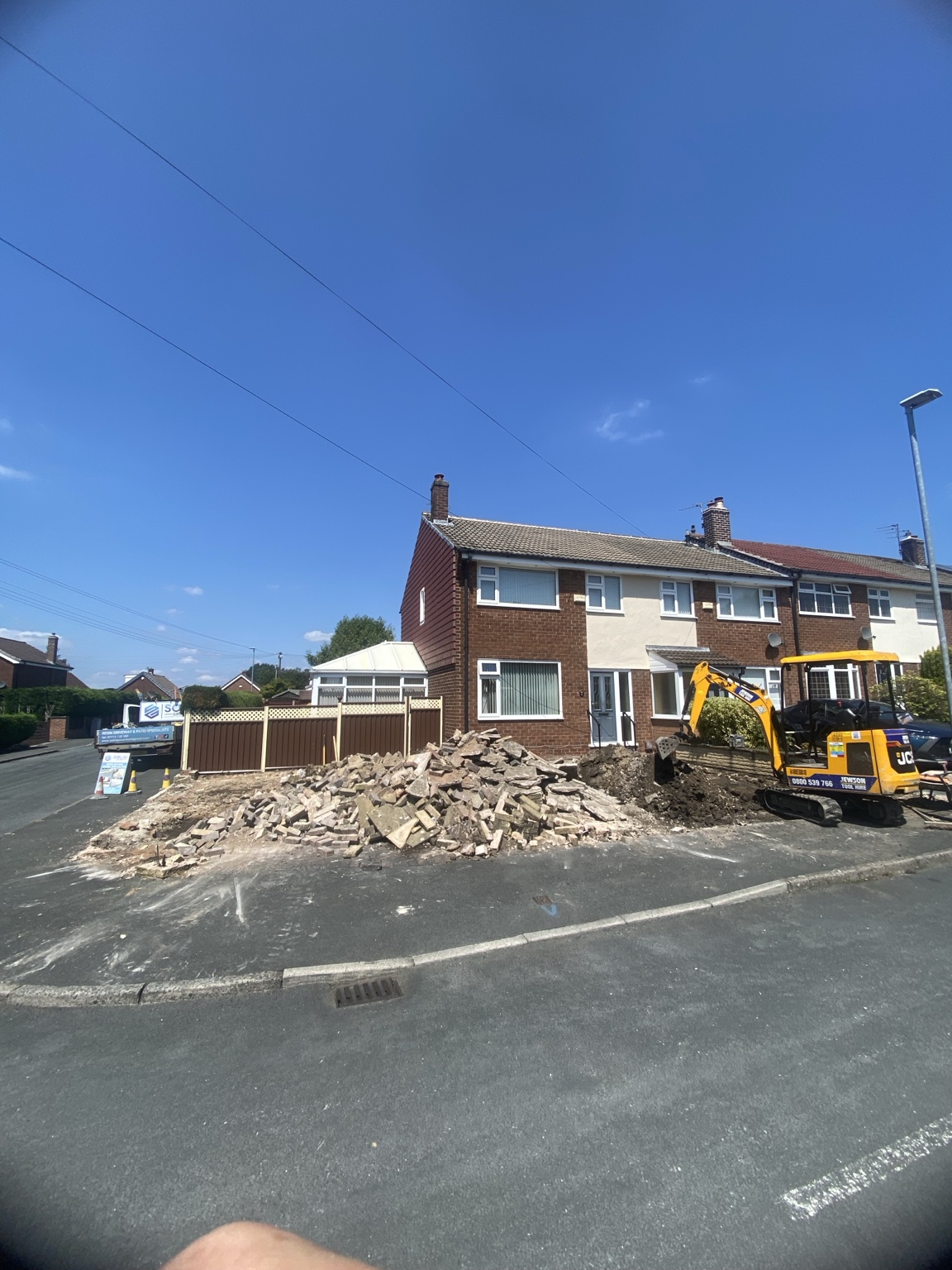
Why resin driveways fail is one of the most important questions to ask before choosing an installer. Some surfaces stay attractive for years while others crack, lift, fade or develop loose stone. The answer is usually not the appearance of the aggregate. Most serious problems begin with the base, drainage, materials or installation conditions beneath and around the finished surface.
This guide explains the most common causes of resin-driveway failure and what homeowners should ask before accepting a quotation. Solid Ground installs resin-bound driveways across Manchester, Tameside and Stockport, including complete excavation, groundwork, drainage, borders and landscaping where required.
1. An Unsuitable or Unstable Base
A resin-bound surface is a relatively thin decorative wearing course. It cannot make a weak foundation strong. If the material underneath moves, settles or breaks apart, that movement can eventually show through the resin as cracking, depressions or failed areas.
For a complete new installation, the existing driveway, loose paving, lawn or unsuitable material may need to be excavated. The required construction depends on the site, ground conditions, anticipated vehicle use and drainage design. A correctly prepared and compacted sub-base, together with a suitable resin-ready base, provides the stability the finished surface needs.
2. Laying an Overlay on a Damaged Surface
Resin can sometimes be installed over suitable existing tarmac or concrete, but an overlay is not appropriate for every driveway. The existing surface must be stable, sound and properly bonded, without major movement, contamination or widespread cracking.
Covering a failing base may hide the defects briefly, but it does not remove them. Existing cracks can reflect through the new surface and loose areas may continue to move. A proper survey should establish whether an overlay is genuinely suitable or whether full excavation is the more reliable option.
3. Poor Drainage or the Wrong Base Design
Resin-bound aggregate contains interconnected spaces that allow water to pass through the surface. For the complete system to work as a permeable installation, the construction underneath must also be designed to deal with that water.
Drainage problems can arise when water reaches an impermeable or poorly graded base with nowhere suitable to go, when falls direct water towards the house, or when channels and outlets are omitted where they are needed. Standing water, trapped moisture and frost can all place additional stress on a driveway.
Homeowners planning a front driveway should also check the official Planning Portal guidance on paving a front garden. Permeability, water direction and the area being surfaced can affect what is required.
Related technical guides: resin driveway thickness and UV-stable vs non-UV resin.
4. Incorrect Mixing or Insufficient Resin
Resin-bound surfacing relies on a controlled mix of dried aggregate and the correct resin system. Every batch needs consistent quantities and thorough mixing so the stone is properly coated before it is spread and hand-trowelled.
Too little resin, inconsistent batches or poor mixing can leave weak areas and loose aggregate. Changing the blend or proportions partway through the installation can also create visible differences across the surface. Accurate batching and an organised mixing process are essential.
5. Damp Aggregate or Installation in Unsuitable Weather
The aggregate used for resin-bound surfacing must be dry, and the installation conditions need to suit the resin system. Moisture introduced during mixing or laying can interfere with the finish and contribute to foaming, cloudiness or weak bonding.
Rain, surface moisture and unsuitable temperatures can affect when the final resin layer can be installed. A responsible contractor should adjust the programme when conditions are not right, even if this changes the planned completion day.
6. Weak or Missing Edge Restraints
The resin surface needs secure edges around the perimeter, entrances, planting areas, steps and drainage details. Block paving, kerbs or another suitable restraint normally provide a firm boundary for the hand-trowelled material.
Poorly constructed edges are vulnerable to movement and damage, especially where vehicle tyres repeatedly cross the driveway entrance. Borders are not only decorative; they form part of the driveway construction.
7. Traffic Before the Surface Has Cured
A newly installed resin driveway needs time to cure before it is opened to pedestrians or vehicles. The required period depends on the resin system, temperature and weather. Using the surface too early can mark or damage it before it has reached the necessary strength.
Your installer should explain when the driveway can be walked on and when vehicles can return. Those instructions should be treated as part of the installation, not an optional precaution.
8. Damage and Lack of Basic Maintenance
Resin-bound driveways are designed to be low maintenance, but they are not maintenance-free. Leaves, soil and organic material should be removed before they build up. The surface can be cleaned periodically using an appropriate method, and fuel, oil or chemical spills should be dealt with promptly.
Heavy skips, sharp metal objects, vehicle jacks and concentrated loads can damage many driveway surfaces. Protective boards may be needed when unusually heavy items are placed on the drive. Small defects should be inspected early rather than allowed to spread.
What a Good Resin Driveway Quotation Should Explain
A useful quotation should describe more than the resin colour and total price. Before choosing an installer, ask for clarity on:
- Whether the job is a full excavation or an overlay
- The proposed sub-base and resin-ready base
- How rainwater will be managed
- The border, entrance and edge construction
- The resin and aggregate system being used
- Any steps, paths, walls or landscaping included
- Waste removal and site access
- Expected installation and curing times
- Aftercare and what happens if a defect appears
Choose the Construction, Not Only the Colour
Colour samples and finished photographs are important, but the hidden construction determines whether a resin driveway performs properly. Look for genuine before, groundwork and completed photographs, and ask the installer to explain why the proposed base and drainage approach suit your property.
You can view genuine Solid Ground projects and the detailed 73m² Newton, Hyde case study to see how the preparation and finished design fit together.
Manufacturer guidance from Derbyshire Specialist Aggregates explains that resin-bound surfacing requires a stable base suitable for the expected load, and that gravel, soil, block paving, flags and similar jointed or loose surfaces are not normally suitable direct bases. Read its resin-bound base guidance.
Related Resin Driveway Guides
Compare current prepared-base, overlay and full-installation figures in our Manchester resin driveway cost guide for 2026.
For drainage-specific guidance, read are resin driveways permeable? and how the base affects the complete system.
For more detail on the construction underneath, read what makes the best base for a resin driveway. You can also compare resin-bound and resin-bonded surfacing so you know which system a quotation is describing.
Request a Resin Driveway Survey
If you are considering a resin driveway in Hyde, Tameside, Stockport, Manchester or the surrounding areas, Solid Ground can inspect the existing surface, discuss drainage and design options, and provide a written quotation based on the construction your property requires.